
Welcome World
THE TFM COLLECTION
Every successful organism must FIGHT TO ENDURE
One Expansive Collection
TFM is a digital museum exploring how struggles in sport, war, and society shaped America, 1890–1929.
This presentation is made possible through the generous support of The Huckleman Family. Thank you.
*
COLLECTION MENU > TFM Collection, > TFM Music Collection >< TFM Print Collection
*
COLLECTED MATERIALS
Evidence. Interpretation. Understanding.
At its core, The TRIPLE FIGHT MUSEUM is an evidence-focused institution.
Everything we present—every story, every insight, every question—begins with the materials in our care.
These materials are not illustrations of history. They are evidence of lived experience.
Why the Collection Matters
The TFM Collection brings together a wide range of historical materials that document life between 1890 and 1929—a period defined by:
- contests within the boxing ring
- conflicts among nations
- and the ongoing fight for equality and justice
Taken together, these materials allow us to examine not only what happened—but how it was experienced, understood, and shared by the people of that time.
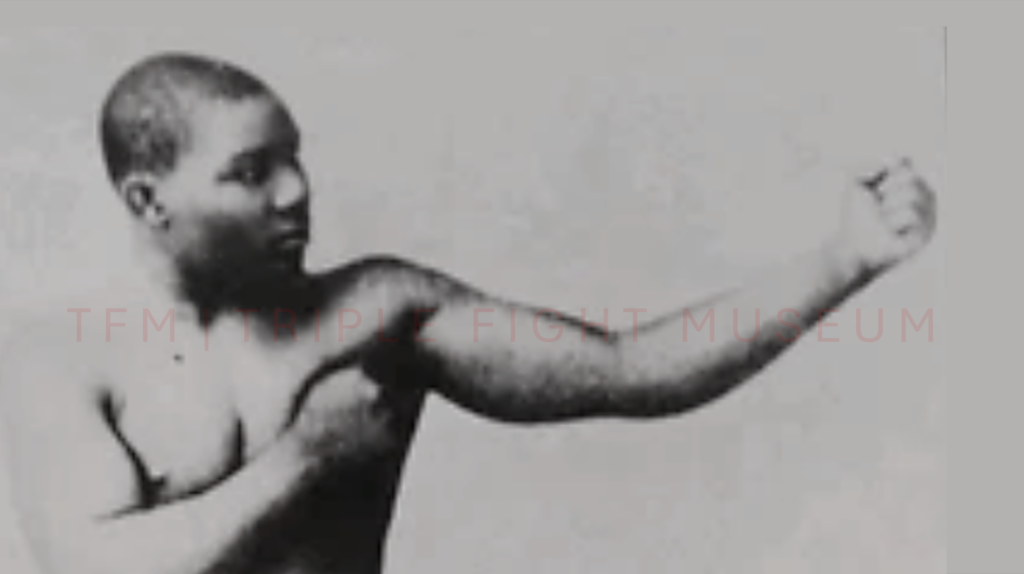
Photo: Barbados Joe Walcott won the World Welterweight Title in 1901 and held it until 1906. He was the first Black man to hold the title, and while other boxing sources acknowledge this important career achievement, at TFM, we view his championship as an invitation to learn more. Why was this man of the Caribbean in America, and what conditions led him to leave his homeland? What did he experience when he arrived in America, and what led him to become a boxer? Did he have experiences similar to those of European immigrants who became prominent boxers, and if not, how were his experiences different? Who were his ring rivals, and how did he rise to the championship ranks? With such questions, we have the beginning of lived histories, and that is the care with which TFM approaches every boxer featured in its collection.
An Evidence-Based Approach
At TFM, interpretation begins with evidence.
We study objects closely—images, texts, sounds, and artifacts—to understand:
- how events were presented
- how individuals were perceived
- and how meaning was shaped in real time
From that foundation, we develop interpretations grounded in what the materials reveal.
Like all serious institutions, we recognize that interpretation is not fixed.
As new materials come into view, or as existing materials are reconsidered, our understanding may evolve—sometimes subtly, sometimes significantly.
This is not a weakness.
It is the discipline of working honestly with evidence.
Understanding the Past—With Purpose
Our aim is not to impose present-day thinking onto the past.
It is to understand the past as it was experienced by those who lived it—
and then to thoughtfully interpret those experiences in ways that resonate today.
Through this process, TFM seeks to do something essential:
To help individuals look more closely, see more clearly, and think more deeply—
so that wiser, more informed decisions can be made in the present and future.
COLLECTION MENU > TFM Collection, > TFM Music Collection >< TFM Print Collection
Now Launching: The TFM Centennial PLUS Campaign
Join the Work
Every effort to preserve and share meaningful history requires support.
The TFM Centennial-PLUS Campaign provides a way to take part in this work—helping ensure that these stories are not only told, but endure.
Remember: FREEDOM is never FREE and GOOD requires MIGHT.
Join the FIGHT
Become a Member | Support the Centennial | Explore the Collection
TFM – In the FIGHT FOR GOOD