
Welcome World
On The Card
TFM Presents
On The Card – ABOUT This Series
On the Card is a series of essays highlighting various cards in the TFM Collection
About OTC
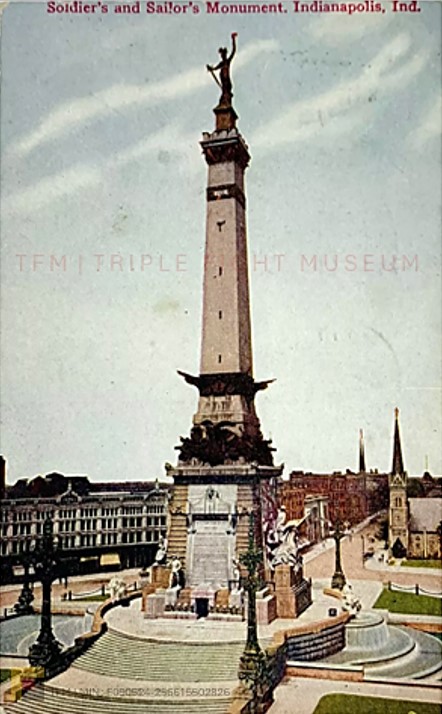
Soldiers’ and Sailors’ Monument
Indianapolis, Indiana
Rising from the center of the city, this monument was built to honor those who served in the Civil War and other conflicts that followed. It stands not only as a memorial, but as a statement about how a nation chooses to remember sacrifice and define service.
Postcards like this capture more than architecture. They preserve how a place wished to be seen—orderly, proud, and unified—while leaving open the question of who was included in that vision, and who was not.
Finding meaning in objects is at the heart of what we do at TFM. With that spirit in mind, I’m pleased to share a few thoughts about one of our featured segments: On the Card.
An Early Impulse to Collect
We all have proclivities that emerge early in life, and for me, collecting was one of them. As a child, I enjoyed collecting all sorts of things: fireflies, marbles, coins, stamps, comic books, and, for a while, baseball cards. As I entered my teen years, I gradually lost interest in those early collections.
It would be decades before I returned to collecting.
This time, I was motivated by a different purpose–not accumulation, but learning from objects that helped me to better understand the world from 1890 to 1929.
A Different Kind of Collection
Today, the cards in the TFM Collection offer something more enduring:
A glimpse into how people once saw their world.
Some cards are visually striking. Others are worn, faded, or marked by time. Yet each holds the possibility of insight. And after two decades of purposeful collecting, I have learned that insights are often revealed—if we are willing to look closely.
Why “On the Card” Exists
On the Card was created to make space for that kind of looking.
Not rushed.
Not surface-level.
But attentive–by design.
This series exists to help us do more than look at historical objects—it helps us learn how to see what they reveal.
What You Can Expect
In each feature, we take a single card and ask a series of questions:
- What stands out?
- What does it show us about place, time, and use?
- How does it connect to the three fights that define THE TRIPLE FIGHT?
- What else begins to emerge when we stay with the image a little longer?
These questions are based on the methodology of the TFM 6-Part Framework—but they are not confined by it. Some pieces will clearly reflect all parts of the framework. Others will move more fluidly.
What remains constant is the discipline of observation.
Looking and Seeing
There is a difference between looking and seeing.
Looking is immediate.
Seeing takes time.
It requires patience, curiosity, and a willingness to question what first appears obvious.
At TFM, we are not simply presenting images from the past.
We are working to cultivate a way of seeing that allows those images to speak more fully.
A Living Card Collection
The TFM Collection is not static.
It grows, not just in size, but in meaning.
Cards are added because they contribute to an evolving understanding of ideas, people, places, and events.
When it comes to people, we prioritize understanding the conditions under which they lived, worked, and struggled.
This means we pay attention to the places where struggles unfolded.
Sometimes a single card introduces a place.
More often, it is through multiple images—gathered over time—that a fuller picture begins to emerge.
Our Invitation
On the Card is our invitation.
To slow down.
To look again.
To ask better questions.
And to discover that even the smallest objects—cards that might otherwise be overlooked—can carry within them an expansive view of the world.