
Welcome World
On The Card
From the Founder and Director of TFM
TFM Presents
From Myth to Modern:
A Small Card and the Origins of Boxing
On the Card is a series of essays highlighting various cards in the TFM Collection
April 2026 – Volume 01, Number 01
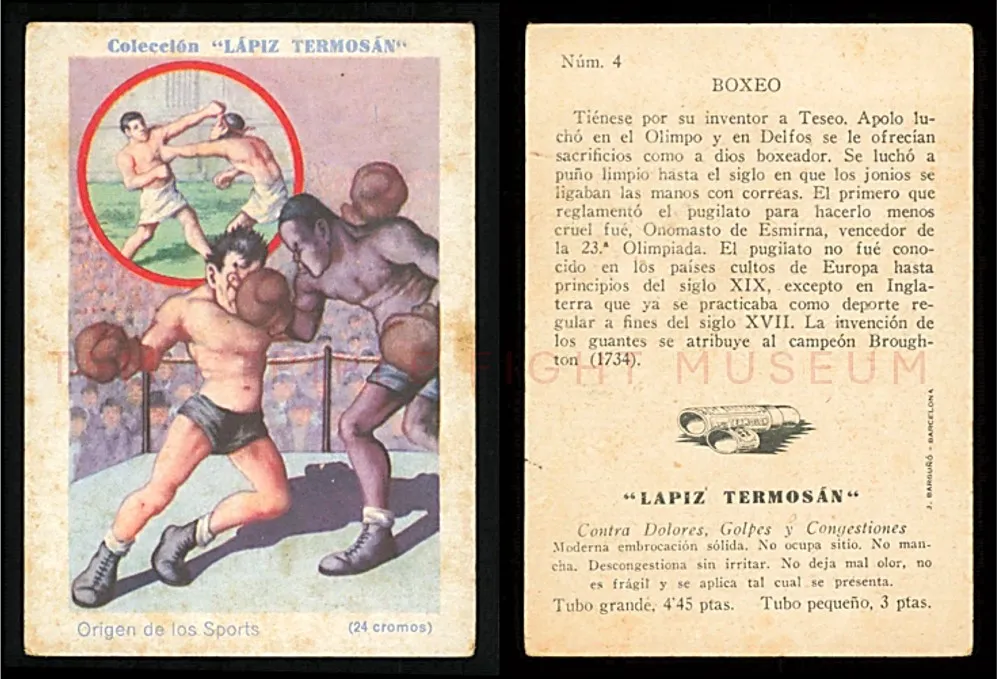
This Spanish trade card from the “Origen de los Sports” series presents a stylized illustration of a boxing match, accompanied by a historical narrative of pugilism. Produced by Lapiz Termosán in Barcelona, the card reflects early 20th-century European interpretations of boxing’s origins, blending classical mythology with modern sporting culture. The front depicts an active bout before a crowd, while an inset image highlights earlier forms of combat, underscoring boxing’s ancient roots and ongoing evolution. The reverse provides a concise history of the sport, tracing its mythical beginnings through its formalization in Europe. (See TRANSLATION below.)
As both an educational object and promotional material, the card exemplifies how boxing was framed as a disciplined, regulated sport emerging from more primitive forms of combat.
SEEING AND LEARNING
2026
Written by
Dan Perkins
Founder & Director
TRIPLE FIGHT MUSEUM (TFM)
Thank you for stopping in to see this new addition to TFM.
When you arrived on this page, you probably scrolled down and paused a moment to gaze upon the image above, and while there, you may have thought to yourself, “Wow, that card doesn’t look like anything you would find in a traditional museum.” And you are absolutely correct. Most museums only display pristine objects.
But I would like for you to remember; One, life is messy. Two, fights take their toll, and three, this is not a traditional museum.
You will experience many things here that you are not likely to encounter in a traditional museum.
At THE TRIPLE FIGHT MUSEUM, we use a six-part framework to guide how we examine objects.
We begin with a simple question:
What does this object have to do with THE TRIPLE FIGHT?
From there, we ask:
What stands out ABOUT the object—its physical form, its place of origin, and its intended use?
We then consider how the object connects to the three fights that make up THE TRIPLE FIGHT—F1, F2, and F3.
And finally, we ask:
What OTHER elements of the object deserve our attention?
Now that you know our framework, let’s see how it can guide our study of today’s colorful and informative card.
THE OBJECT AND THE TRIPLE FIGHT
This object clearly lives in F1 — Fights in Rings, where boxing emerges not simply as combat, but as a disciplined and evolving sport.
Yet it does not remain confined to the ring. It extends outward—into culture, into commerce, and into the ways societies interpret struggle and shape its meaning.
ABOUT THE OBJECT
Produced in Barcelona as part of the “Origen de los Sports” series, this illustrated trade card presents boxing as both ancient tradition and modern sport.
The front depicts an active bout before a crowd—gloves raised, bodies in motion—while a smaller inset image gestures toward earlier, less structured forms of combat. The reverse offers a concise narrative tracing boxing’s evolution from mythological origins to regulated sport.
As both an educational object and promotional material, the card reflects a moment when boxing was being framed not only as physical contest, but as a subject worthy of explanation and order.
THE FIGHTS OF THE TRIPLE FIGHT
So, let’s take a moment to see how the card aligns with the three fights that define THE TRIPLE FIGHT.
F1 — FIGHTS IN RINGS
Here, boxing is presented as disciplined competition, not savagery.
The card emphasizes:
- the movement from bare-knuckle fighting to gloved competition
- the introduction of rules to reduce brutality
- the transformation of instinct into technique
It reflects a period in which boxing was being reshaped for modern audiences—structured, regulated, and increasingly recognized as sport rather than spectacle.
F2 — FIGHTS AMONG NATIONS
While not a military object, the timing of its production is significant.
Emerging in the years following the First World War, this card reflects a broader cultural moment in which societies sought forms of controlled conflict—spaces where struggle could be contained, measured, and understood.
In this sense, the boxing ring can be seen as mirroring a wider desire for order after a period defined by upheaval.
F3 — FIGHTS FOR EQUALITY & JUSTICE
The card clearly depicts two boxers, one white, the other Black. This is an important observation given the era in which the card was published.
The card does not convey the racial tension present in the United States at the time—and for good reason.
It was produced within a culture different from American society, one that did not carry the same legacy of centuries-long racial enslavement and the structures that followed from it.
That distinction matters.
Because it reminds us that different places, and different conditions, yield different expressions—and different interpretations.
What we see on this card is not a resolution of tension, but a reflection of perspective. A way of seeing the fight that is shaped by its own cultural context.
And that is where the work begins.
Because what we are attempting to do in these moments is move beyond the surface of the object—to consider the stories behind the story.
Stories that broaden our understanding of the past, and deepen our awareness of how that past continues to shape the present.
OTHER — COMMERCE AND EVERYDAY LIFE
At the bottom of the card, an advertisement for Lapiz Termosán promotes a liniment for “pain, blows, and congestion.”
This detail is revealing.
The same object that explains the origins of boxing also acknowledges its physical consequences—and offers a remedy.
The fight produces injury.
The marketplace produces relief.
In this way, the card exists not only as representation, but as part of a broader system in which sport, commerce, and daily life intersect.
A TFM REFLECTION
What this card ultimately offers is more than something colorful to look at, and something more than a history of boxing.
It offers a way of thinking about how struggle is defined and understood–a pair of white and Black boxers in 1920s Florida is a totally separate affair than one in 1920s Barcelona.
Ultimately, our little Spanish boxing card invites us to think about how struggle is understood—across time, across place, and across perspective.
I began this piece by asking what this object has to do with THE TRIPLE FIGHT.
Along the way, we considered what stands out about it—its imagery, its origins, and its purpose.
We then looked at how it connects to the three fights that define THE TRIPLE FIGHT, and what those connections reveal.
And finally, we asked what other elements deserve our attention—and what they might teach us.
This is the work.
Not simply to look at an object, but to stay with it long enough to see what it has to offer.
Because even a small card—worn, weathered, and easy to overlook—can carry within it a way of understanding the world.
TRANSLATION by ChatGPT
English Translation:
Boxing
Boxing is attributed to Theseus as its inventor. Apollo fought on Olympus, and in Delphi sacrifices were offered to him as a god of boxing. Combat was fought with bare fists until the time when the Ionians bound their hands with straps. The first to regulate boxing in order to make it less cruel was Onomastus of Smyrna, victor of the 23rd Olympiad.
Boxing was not known in the cultured countries of Europe until the beginning of the 19th century, except in England, where it was already practiced as a regular sport at the end of the 17th century. The invention of gloves is attributed to the champion Broughton (1734).
Original (Spanish):
“Boxeo
Tiénese por su inventor a Teseo. Apolo luchó en el Olimpo y en Delfos se le ofrecían sacrificios como a dios boxeador. Se luchó a puño limpio hasta el siglo en que los jonios se ligaban las manos con correas. El primero que reglamentó el pugilato para hacerlo menos cruel fue Onomasto de Esmirna, vencedor de la 23ª Olimpiada. El pugilato no fue conocido en los países cultos de Europa hasta principios del siglo XIX, excepto en Inglaterra que ya se practicaba como deporte regular a fines del siglo XVII. La invención de los guantes se atribuye al campeón Broughton (1734).”
COLLECTION MENU > TFM Collection > TFM Music Collection >< TFM Print Collection
About TFM and F1-FIGHTS in RINGS (Boxers and Boxing). TFM is committed to telling the history of boxing as an international sport and with the broadest lens possible. We pay particular attention to ways in which boxing was cultivated and positioned in America to advance notions of power, masculinity, virtue, dominance, and opportunity from the outset of the American Empire in 1890, through the 1920s. Through multiple presentations, TFM illustrates how boxing functioned not only as a sport but as a powerful lens through which life was experienced, interpreted, and remembered during the four decades that best reflect THE TRIPLE FIGHT (1890-1929).
Coming Soon
More of F1
FIGHTS IN RINGS
(Boxers and Boxing)